The Silhouette Wars
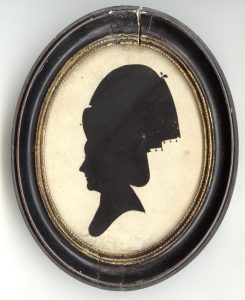
Sarah Carter and Ann Shillard were both baptised in 1745, in London and Bath respectively. Within a year of each other, they both married widowers becoming Mrs Harrington and Mrs Collins respectively. Exactly when the two ladies became known to each other is unrecorded. Sarah Harrington was touring the country with her silhouette cutting business as early as 1772 whereas Ann Collins was on the provincial theatre circuit with her actor husband. Around 1776 Sarah engaged Ann as her pupil and assistant to help her keep up with the demand for profiles.
Uniquely, Sarah produced ‘hollow-cut’ silhouettes where the profile was cut out of white paper but it was the surrounding paper that was retained and backed with either black paper or silk. In June 1775, she successfully patented a mechanical device – later referred to as a ‘Royal Andrograph’ – for ‘taking and reducing [such] likenesses … with amazing dispatch’. She trained Ann in how to use this device to produce work in the same style as her own.
Within months both ladies had amicably parted ways, Sarah continuing her tour of cities as an itinerant artist and Ann to follow her actor husband. But Ann now had a new string to her bow as she had just purchased a 50% share of Sarah’s Patent for £60 (equating to over £10,000 in today’s money) enabling her to now cut hew own profiles commercially.
This is when the Silhouette Wars broke out, not between the two ladies but with other impostors and ‘insolent foreigners’. The action was covered by the Leeds Intelligencer in late 1776. The first imposter was a Signor Rosso from Italy whose arrival in Leeds to offer Striking Likenesses in profile for 2s 6d coincided with Sarah Harrington’s own stay in Leeds. She must have quickly challenged Rosso as he wrote to the paper to claim that Mrs Harrington had no Patent and was ‘only a pretender to such privilege’. At this point, the Patent was laid out for inspection by the Editor and several gentlemen of the law who declared it valid. The ‘insolent foreigner’ was then successfully prosecuted.
But Signor Rosso was not the only artist who thought they could make some easy money from cutting silhouettes. A couple from Halifax, James and Sarah Hall (both illiterate), were likewise threatened with prosecution and obliged to publish an apology for falsely claiming that they too had a Royal Patent for cutting silhouettes. Another case emerged in Manchester when an anonymous lady demanded and duly received proof of the Patent.
The Patent was granted for a period of fourteen years so would have expired in mid-1789. By then both ladies had already hung up their scissors. The existence of the Patent may though go some way to explaining why hollow-cutting as a technique was not widely practised in the British Isles unlike in the United States where it was much more widely favoured.